Healthcare in Egypt from first clinic visit to insurance coverage

Content authorBy Dr. Haydy kheirPublished onReading time8 min read
Confident adult in a bright Egyptian medical clinic after weight loss, surrounded by elegant minimalist design and natural light.

This article explains how healthcare in Egypt works when you're arranging planned treatment rather than reacting to an emergency. It follows the sequence from choosing a provider through to the paperwork you'll need afterwards.

How healthcare in Egypt works

Healthcare in Egypt runs on three parallel tracks that rarely feel like one system to a patient arriving from abroad. There's the public network under the Ministry of Health and Population and the private sector, with university teaching hospitals alongside both. Where you walk in the door decides almost everything that follows.

That decision shapes how quickly you see a specialist and how the bill gets settled. The Ministry of Health and Population operates over 5,300 primary healthcare facilities and 521 hospitals, while the private sector runs more than 1,100 hospitals. Both exist in the same city. They work differently.

Where patients receive care

Three provider layers of healthcare in egypt cover the country, and each one has a different relationship with planned, non-emergency treatment. Knowing which one you're dealing with removes most of the confusion around scheduling and billing.

Public health facilities

The public network starts with primary care units, which handle family medicine and first-line diagnosis. Above them sit district and general hospitals for inpatient care and specialist departments. Referral moves you upward through that structure rather than sideways.

Under the reform, public facilities in the governorates already covered by the new insurance system have moved to the Egypt Healthcare Authority, which the P4H Network describes as the body regrouping most public health care facilities under a single governance structure. Elsewhere they remain under the Ministry. For a visitor arranging elective treatment, the public network is rarely the practical entry point, because eligibility and scheduling are built around resident citizens.

Private clinics in egypt

Private providers carry most non-emergency and elective work. Private hospitals in egypt account for 63% of all hospitals in the country, though the sector is fragmented and averages 31 beds per facility against 96 in government hospitals. That fragmentation matters less than the access it buys you.

Cairo and Alexandria hold the densest concentration of private capacity along with Giza and Hurghada. Booking works differently here, because private hospitals allow direct appointments with specialists without the referral step public hospitals require. English-speaking clinicians are more common in these cities, which is the practical reason most international patients end up in private clinics in egypt rather than anywhere else.

The trade-off is financial. Out-of-pocket spending equalled 62.7% of total health care expenditure in 2019, against a global average of 18.1%. Patients pay directly, and the system is built around that expectation.

Start Your Medical Journey

Book a free consultation with our care coordinators — we'll help you plan a personalized medical journey in Egypt.

Get a Free Quote

University teaching hospitals

Teaching hospitals belong to the Ministry of Higher Education rather than the Ministry of Health, and there's at least one in every governorate with a medical school. They handle complex cases and train clinicians. Their reputation inside Egypt is built on specialist depth.

The National Cancer Institute of Cairo University is the clearest example. Founded in 1969 as an independent school of Cairo University with a 270-bed hospital, it now receives over 100,000 new patients annually and performs more than 10,000 major surgeries. In September 2025 it was accredited as an Anchor Centre in the International Atomic Energy Agency's Rays of Hope network. None of that means an international patient can simply book there, and access rules differ from what private clinics in egypt offer.

Egypt's insurance institutions
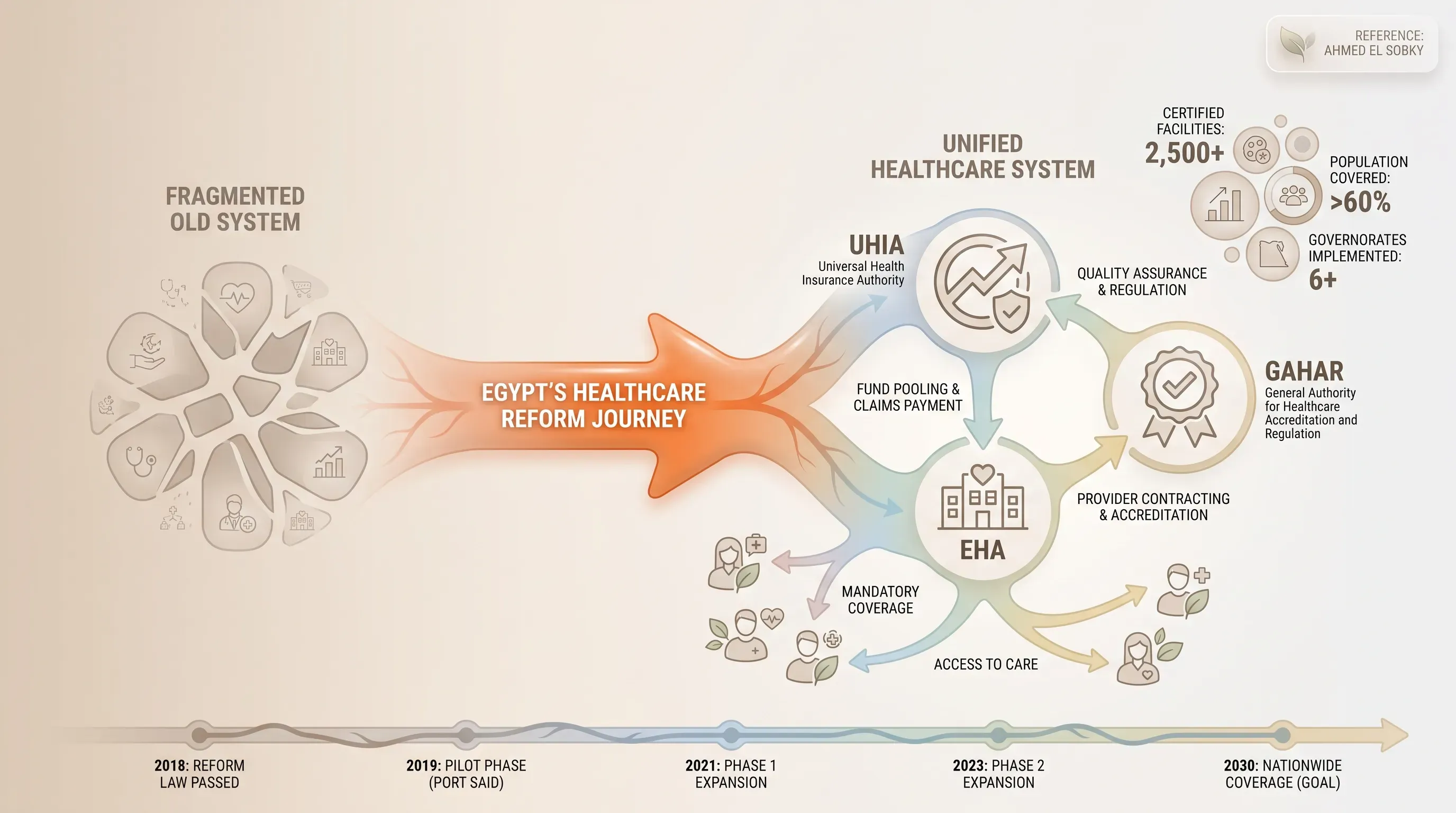
Flowchart illustrating Egypt's healthcare reform, featuring a transition from an old system to unified icons, with citizen coverage and stats.

The 2018 reform of healthcare in egypt replaced a fragmented arrangement with three named bodies, each doing one job. Law No. 2 of 2018 creates mandatory coverage for Egyptian citizens and residents and splits purchasing from provision, with implementation across all governorates required by 2032.

Here's how the three divide the work:

  • The Universal Health Insurance Authority (UHIA) is the single payer. It collects and pools funds and pays claims for its beneficiaries. Contracts run for a maximum of three years and renew only if quality standards are met.

  • The Egypt Healthcare Authority (EHA) is the public provider arm, established under the same law as the public healthcare service provider responsible for unifying and renovating state-owned facilities.

  • The General Authority for Healthcare Accreditation and Regulation (GAHAR) accredits providers so they're eligible to contract with UHIA. Its standards are recognised by the International Society for Quality in Health Care (ISQua).

Ahmed el Sobky, chairman of the Egypt Healthcare Authority, has said that accreditation is a requirement for facilities to join the insurance system, after 276 healthcare facilities across six governorates were certified in July 2025. Of those, 196 held full GAHAR certification and 80 were provisional.

The phased insurance rollout

The system started as a pilot in Port Said in 2019 and expanded from there, chosen partly because more than 90% of its population lives in urban areas and old-system insurance coverage there already exceeded 60%. Familiarity made the transition easier.

Ismailia and Luxor followed, then South Sinai, then Suez and Aswan. Six governorates now form the completed first phase. In Luxor the Universal Health Insurance Authority reported 1,289,697 citizens registered out of a population of 1,449,098, with 5.6 million healthcare services delivered in the 2024/2025 fiscal year at a cost of LE 3.19 billion.

Everywhere else, the older Health Insurance Organisation arrangements still apply, and that covers Cairo and Alexandria. The HIO was created in 1964 to cover government employees and by the mid-2000s reached no more than 59% of the population. Prime Minister Mostafa Madbouly has reviewed amendments ahead of a second phase covering five more governorates, with Alexandria under study. Greater Cairo comes last, in the final phase.


Start Your Medical Journey

Book a free consultation with our care coordinators — we'll help you plan a personalized medical journey in Egypt.

Get a Free Quote

Your care journey

None of the institutional structure of healthcare in Egypt changes what a planned treatment actually looks like from the inside. The sequence is consistent across hospitals in egypt that handle international patients, and knowing it in advance is what stops small gaps from becoming delays.

  1. Choose a facility and specialist, then send your medical records ahead. Scans, lab results, and previous surgical notes carry more weight than a written summary.

  2. Attend the consultation. You'll be asked for your passport at a first visit to a private clinic or hospital, so bring it along with your insurance documents.

  3. Complete diagnostic tests. Some are done same-day on site, others require a separate appointment.

  4. Receive a treatment plan, then either a referral to another department or admission for the procedure itself.

  5. Undergo treatment, then discharge with written instructions and a follow-up schedule.

Two points in that chain create most of the friction. Scheduling is one, because tests and surgery slots don't always align with a fixed travel window. Translation is the other. English is common in the private sector in the four main cities, but consent forms and discharge notes are frequently issued in Arabic.

Payment and insurance

Egyptian facilities commonly ask for money before treatment starts. AXA Global Healthcare states that public and private hospitals in egypt alike require upfront cash payments or security deposits, and that this applies even to patients who already hold private health insurance. The insurance pays you back later.

If you're travelling from within Europe, the European Health Insurance Card has no standing in healthcare in egypt. Norway's Helsenorge states plainly that the card cannot be used outside the EU/EEA or the United Kingdom. Egypt falls outside all of those. Most EHIC schemes also exclude cover where treatment is the main reason for the trip, which describes elective medical travel exactly.

So the working assumption is pay-and-reclaim. Ask your insurer before you fly whether they'll issue a guarantee-of-payment letter directly to the hospital, because a direct-billing arrangement removes the need to produce a large sum at admission. If they won't, keep a reserve available.

Documents to collect

Reimbursement fails on missing paperwork more than on disputed treatment. Confirm what your policy authorises before treatment begins, and keep everything the facility hands you.

  • Written coverage authorisation from your insurer, plus any guarantee-of-payment letter issued to the hospital

  • Full provider details, including the facility name and treating clinician

  • The treatment plan and signed consent records, in a language you can read

  • Itemised invoices and payment receipts for every transaction, including diagnostics and pharmacy

  • Medical reports and the discharge note with follow-up instructions

Ask for itemised billing at the point of payment rather than afterwards. A lump-sum receipt tells an insurer nothing about what was treated, and reconstructing that record from another country is slow work.

Blissed Egypt's role

Coordination is where most of the difficulty in planned treatment sits, and it's non-clinical work. Blissed Egypt handles that side through case review and specialist matching. The company works with hospitals in Egypt and clinics in egypt across Cairo and Alexandria, as well as Giza and Hurghada.

Clinical responsibility stays where it belongs. Your treating doctor makes the diagnosis and takes your consent. If you're weighing up healthcare in Egypt for a planned treatment and want the logistics handled before you fly, contact a Blissed Egypt care coordinator for a consultation.

Start Your Medical Journey

Book a free consultation with our care coordinators — we'll help you plan a personalized medical journey in Egypt.

Get a Free Quote

Get written confirmation from your insurer before booking treatment. Give the insurer the hospital name, specialist, expected procedure, and estimated costs, then ask whether it will pay the hospital directly or reimburse you after payment. Keep the approval reference with your travel documents.

Ask the hospital for an English version or a certified translation before you sign consent forms or leave after treatment. Check that translated invoices identify each service and payment. Your insurer needs records it can review, and you need discharge instructions you can follow safely.

Arrange the follow-up before discharge, especially if you have a fixed return flight. Confirm the date, the clinician, and whether the review can happen by video after you return home. Ask the treating doctor which symptoms require earlier medical attention.

Ask the facility to send signed digital copies to you and, where required, to your insurer. Request the laboratory or imaging report as well as the images themselves. Keep a copy of the message that confirms the result was issued and who reviewed it.

Blissed Egypt can coordinate non-clinical parts of planned healthcare in egypt, including case review and specialist matching in Cairo, Alexandria, Giza, and Hurghada. Your treating doctor remains responsible for diagnosis, consent, and clinical decisions. Ask the coordinator what documents and booking details are needed before travel.

Start Your Medical Journey

A free consultation with one of our experts within 24 hours of your request.

You Might Also Like

Discover more insights and articles

No similar articles available at the moment.